
Table of Content
- Introduction
- What Are Chelated Minerals?
- Why Trace Minerals Matter in Poultry?
- Bioavailability: The Key Advantage of Chelated Minerals
- Impact on Growth Performance
- Strengthening Immune Function
- Skeletal Development and Leg Health
- Improved Egg Production and Eggshell Quality
- Enhanced Antioxidant Status and Stress Management
- Environmental Benefits of Chelated Minerals
- Can Chelated Minerals Replace Inorganic Minerals Completely?
- Future of Chelated Minerals in Poultry Nutrition
- Conclusion
- Frequently Asked Questions (FAQ)
- About Titan Animal Nutrition
- References
Introduction
Modern poultry production is under constant pressure to improve growth performance, feed efficiency, flock health, and product quality while reducing environmental impact. As feed costs continue to account for the largest portion of production expenses, nutritionists are increasingly focusing on improving nutrient utilization rather than simply increasing nutrient inclusion levels.
Among the essential nutrients required by poultry, trace minerals play a critical role in numerous physiological and metabolic processes. Minerals such as zinc (Zn), copper (Cu), manganese (Mn), iron (Fe), selenium (Se), and chromium (Cr) are involved in enzyme activation, immune function, skeletal development, antioxidant defense, reproduction, and growth. Traditionally, these minerals have been supplied through inorganic sources such as sulfates, oxides, and chlorides. However, the poultry industry has increasingly shifted toward chelated minerals, also known as organic trace minerals, due to their superior bioavailability and utilization.
Recent research demonstrates that chelated minerals can improve bird performance, strengthen immunity, support skeletal health, enhance meat and egg quality, and reduce mineral excretion into the environment. This article explores the science behind chelated minerals and their growing importance in modern poultry nutrition.
What Are Chelated Minerals?
Chelated minerals are trace minerals chemically bound to organic molecules such as amino acids, peptides, proteins, or organic acids. This bonding forms a stable complex that protects the mineral from undesirable interactions within the gastrointestinal tract.
In conventional poultry diets, inorganic minerals may react with phytates, fiber, tannins, oxalates, and other dietary components, reducing their absorption. Chelation shields the mineral from these antagonistic interactions, allowing more efficient transport across the intestinal wall.
Common forms of chelated minerals used in poultry feed include:
- Zinc methionine
- Copper lysine
- Manganese methionine
- Iron amino acid complexes
- Selenium yeast
- Chromium picolinate
- Glycinate-based mineral chelates
The improved stability and absorption of these mineral complexes make them more biologically effective than many traditional inorganic sources.
Why Trace Minerals Matter in Poultry Production?
Although required in small quantities, trace minerals influence numerous biological functions in poultry.
Zinc
Zinc is essential for enzyme activity, protein synthesis, feather development, skin integrity, and immune competence. Deficiency can lead to poor growth, impaired immunity, and reduced feed efficiency.
Copper
Copper contributes to connective tissue formation, iron metabolism, antioxidant defense, and immune function. Adequate copper levels also support growth and productivity.
Manganese
Manganese plays a critical role in bone formation, eggshell quality, and reproductive performance. It is particularly important for skeletal development in broilers.
Iron
Iron plays an essential role in carrying oxygen throughout the body and supporting energy-producing metabolic processes. Insufficient iron can negatively affect growth and overall vitality.
Selenium
Selenium functions as a powerful antioxidant through its role in glutathione peroxidase activity. It helps protect tissues from oxidative stress and supports immune function.
Chromium
Chromium is associated with improved glucose metabolism, stress management, and growth performance, especially under challenging production conditions.
Because these minerals are involved in multiple physiological pathways, improving their availability can have a substantial impact on flock performance.
Bioavailability: The Key Advantage of Chelated Minerals
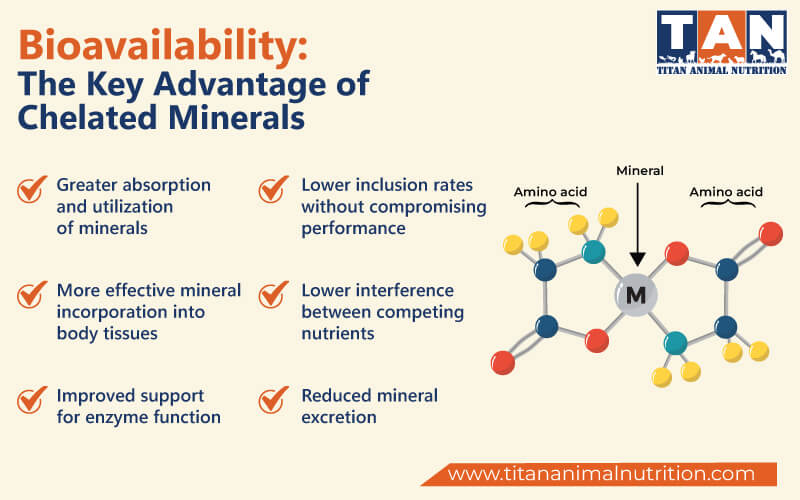
One of the primary reasons for the increasing adoption of chelated minerals is their higher bioavailability. Bioavailability describes how much of a nutrient the body can absorb and effectively use. Research has consistently shown that organically bound minerals are absorbed more efficiently than many inorganic sources.
The enhanced bioavailability of chelated minerals offers several advantages:
- Greater absorption and utilization of minerals
- More effective mineral incorporation into body tissues
- Lower interference between competing nutrients
- Improved support for enzyme function
- Lower inclusion rates without compromising performance
- Reduced mineral excretion
Studies indicate that birds receiving organic trace minerals often maintain or improve performance even when dietary inclusion levels are significantly reduced compared with inorganic mineral programs.
Impact of Chelated Minerals on Broiler Growth Performance
Growth performance remains one of the most important economic indicators in poultry production.
Several studies have demonstrated that replacing inorganic minerals with chelated mineral sources improves body weight gain and feed conversion efficiency.
Research involving broiler chickens reported superior growth performance and improved feed conversion ratios when birds received organic trace minerals supplying zinc, copper, iron, and manganese compared with equivalent inorganic mineral supplementation. Improved nutrient utilization enables birds to convert feed into body mass more efficiently.
Enhanced mineral availability supports numerous metabolic pathways involved in protein synthesis, energy production, and tissue development. As a result, birds are better equipped to achieve their genetic growth potential.
In commercial operations where feed efficiency directly influences profitability, even small improvements can translate into significant economic returns.
Strengthening Immune Function with Organic Trace Minerals
Disease resistance remains a major concern in intensive poultry production systems. The immune system requires adequate trace mineral nutrition to function effectively.
Chelated minerals have been associated with improved immune responses due to their greater absorption and retention.
Zinc plays a crucial role in immune cell development and function. Copper contributes to antioxidant defense mechanisms, while selenium protects immune tissues from oxidative damage.
Studies have shown enhanced immune responses in broilers receiving organic trace minerals compared with birds fed inorganic sources. Improved mineral status supports antibody production, cellular immunity, and overall disease resistance.
As poultry producers seek alternatives to antibiotic growth promoters, nutritional strategies that strengthen natural immunity have become increasingly valuable.
Skeletal Development and Leg Health in Broilers
Rapid growth rates in modern broilers place substantial demands on skeletal development.
Inadequate mineral nutrition can contribute to leg weakness, poor bone mineralization, and locomotion problems that negatively affect welfare and productivity.
Manganese, zinc, and copper are especially important for bone formation and cartilage development. Research indicates that organic mineral supplementation improves mineral deposition in bones and supports stronger skeletal structures.
Improved bone strength not only enhances bird welfare but also reduces economic losses associated with lameness and culling.
Improved Egg Production and Eggshell Quality in Layers
The benefits of chelated minerals are not limited to broilers. Layer operations can also gain significant advantages.
Research has shown that organically sourced minerals can improve laying performance and eggshell quality. Copper methionine supplementation, for example, has been associated with enhanced eggshell characteristics compared with traditional copper sulfate supplementation.
Manganese and zinc are particularly important for shell formation because they contribute to enzyme systems involved in eggshell matrix development.
Strong shells reduce breakage during collection, transport, and storage, thereby improving profitability and product quality.
Enhanced Antioxidant Status and Stress Management
Commercial poultry are frequently exposed to stressors such as heat stress, vaccination programs, transportation, and high stocking densities.
Oxidative stress can impair performance, weaken immunity, and increase susceptibility to disease.
Chelated selenium and chromium have gained considerable attention for their ability to support antioxidant defense systems and improve stress tolerance.
Selenium contributes to the activity of glutathione peroxidase, a critical antioxidant enzyme that protects cellular structures from oxidative damage. Chromium may improve glucose utilization and reduce the physiological impact of stress.
By improving antioxidant capacity, chelated minerals help birds maintain productivity under challenging environmental conditions.
Environmental Benefits of Chelated Minerals in Poultry Production
Sustainability has become a major focus in animal agriculture.
One of the most significant advantages of chelated minerals is the reduction in mineral excretion. Because organic minerals are absorbed more efficiently, less of the supplemented mineral passes through the digestive tract and enters manure.
Studies have demonstrated that lower inclusion rates of organic trace minerals can maintain poultry performance while reducing mineral excretion into the environment.
Reduced excretion of zinc, copper, and other trace elements helps minimize soil accumulation and environmental contamination associated with intensive livestock production.
This advantage aligns with growing regulatory and consumer demands for environmentally responsible farming practices.
Can Chelated Minerals Replace Inorganic Minerals Completely?
Although chelated minerals offer substantial benefits, complete replacement of inorganic minerals may not always be necessary.
Many poultry nutritionists adopt a blended strategy that combines organic and inorganic mineral sources. This approach balances performance benefits with feed cost considerations.
Research suggests that partial replacement strategies can deliver excellent results while maintaining economic efficiency. In many situations, combining organic and inorganic sources provides optimal performance, immunity, and mineral utilization.
The ideal inclusion rate depends on production goals, bird type, environmental conditions, and overall diet formulation.
Future of Chelated Minerals in Poultry Nutrition
As poultry genetics continue to advance, nutrient requirements become increasingly precise. Modern birds demand highly efficient nutrient delivery systems capable of supporting rapid growth, superior feed efficiency, and robust health.
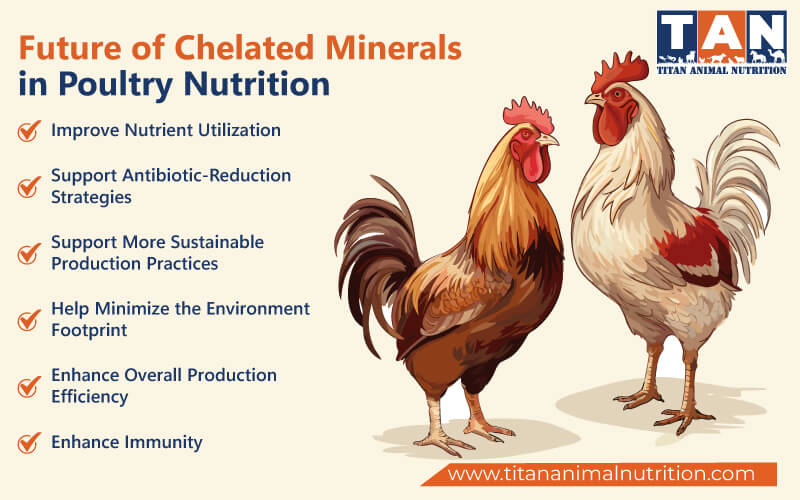
Chelated minerals are expected to play an increasingly important role in future poultry nutrition programs because they:
- Improve nutrient utilization
- Support antibiotic-reduction strategies
- Enhance immunity
- Support more sustainable production practices
- Help minimize the environmental footprint
- Enhance overall production efficiency
Ongoing research continues to explore new chelation technologies and optimized mineral combinations that can further improve poultry performance.
Conclusion
Chelated minerals have emerged as a valuable tool in modern poultry nutrition. By improving mineral bioavailability, they support growth performance, feed efficiency, immune function, skeletal health, antioxidant protection, and egg quality.
Compared with traditional inorganic mineral sources, chelated minerals offer superior absorption and utilization, allowing nutritionists to achieve desired production outcomes with lower inclusion rates. This not only enhances bird health and productivity but also contributes to environmental sustainability through reduced mineral excretion.
As the poultry industry moves toward greater efficiency and sustainability, chelated minerals are likely to become an increasingly important component of advanced feed formulation strategies. Producers seeking to maximize performance while addressing health and environmental challenges can benefit significantly from incorporating scientifically validated chelated mineral sources into their nutrition programs.
Frequently Asked Questions (FAQ): Chelated Minerals in Poultry
Q1. What are chelated minerals in poultry nutrition?
Chelated minerals are trace minerals that are bound to organic compounds, including amino acids, peptides, or proteins. This bonding improves mineral stability and absorption in the digestive tract, making them more bioavailable than conventional inorganic mineral sources used in poultry feed.
Q2. How are chelated minerals different from inorganic minerals?
Inorganic minerals such as sulfates and oxides can interact with other feed components, reducing their absorption. Chelated minerals are protected by their organic ligand, allowing better absorption, utilization, and retention within the bird’s body, which is why Titan Animal Nutrition, a dedicated organic trace mineral manufacturer, supplies chelated forms to poultry feed manufacturers globally.
Q3. Which chelated minerals are commonly used in poultry feed?
The most commonly used chelated minerals include Zinc Methionine, Copper Lysine, Manganese Methionine, Iron Amino Acid Chelates, Selenium Yeast, and Chromium Picolinate. These minerals support growth, immunity, reproduction, and overall flock performance and are all available from Titan Animal Nutrition.
Q4. Do chelated minerals improve broiler growth performance?
Yes, Several studies have shown that chelated minerals can improve body weight gain, feed conversion ratio (FCR), nutrient utilization, and overall production efficiency by enhancing mineral absorption and metabolism, making them a preferred choice for poultry feed additive manufacturers.
Q5. Can chelated minerals help improve poultry immunity?
Yes, Trace minerals such as zinc, selenium, and copper play crucial roles in immune function. Their improved bioavailability in chelated form supports antibody production, antioxidant defense, and disease resistance in poultry, which is particularly valuable in antibiotic-free production systems.
Q6. Are chelated minerals beneficial during heat stress?
Absolutely, Heat stress increases oxidative damage and reduces nutrient utilization. Chelated minerals, particularly selenium and chromium, help strengthen antioxidant defense, support metabolic functions, and improve stress tolerance in poultry under high temperature conditions.
Q7. Can chelated minerals improve bone strength and leg health?
Yes, Zinc, manganese, and copper are essential for bone mineralization, cartilage formation, and skeletal development. Chelated forms of these minerals can improve bone quality and reduce the incidence of leg disorders in rapidly growing broilers, a key concern for commercial poultry producers.
Q8. Do chelated minerals improve egg production and eggshell quality?
Research indicates that chelated minerals can enhance laying performance, eggshell strength, shell thickness, and egg quality by supporting mineral deposition and enzyme systems involved in shell formation, benefiting layer operations and egg processing businesses.
Q9. Can chelated minerals reduce environmental pollution from poultry farming?
Yes, Because chelated minerals are more efficiently absorbed, lower supplementation levels are often required. This results in reduced mineral excretion in manure, helping decrease soil and environmental contamination, which aligns with sustainable poultry farming requirements globally.
Q10. Should chelated minerals completely replace inorganic minerals in poultry diets?
Not necessarily, Many nutritionists use a combination of chelated and inorganic minerals to balance performance benefits and feed costs. The optimal strategy depends on production goals, bird type, environmental conditions, and feed formulation requirements.
Q11. What is the ideal inclusion level of chelated minerals in broiler feed?
The ideal inclusion level varies depending on the mineral source, bird age, production stage, and dietary composition. Feed formulation should follow supplier recommendations and scientific research data. Titan Animal Nutrition provides technical guidance on inclusion rates for all chelated mineral products.
Q12. Are chelated minerals worth the additional cost in poultry feed?
Although chelated minerals are generally more expensive than inorganic sources, their higher bioavailability can improve feed efficiency, growth performance, immunity, and mineral utilization, often resulting in a positive return on investment (ROI) for poultry producers and feed manufacturers.
About Titan Animal Nutrition: Chelated Mineral Manufacturer for Poultry
Titan Animal Nutrition is a specialized animal nutrition ingredient manufacturing unit of Titan Biotech Ltd. As a dedicated chelated mineral manufacturer for poultry and a trusted organic trace mineral manufacturer India-based and globally recognized, we develop and supply a comprehensive range of chelated minerals including zinc methionine, copper lysine, manganese methionine, selenium yeast, chromium picolinate, and iron amino acid complexes to poultry feed manufacturers, premix producers, integrators, and livestock nutritionists across India and international markets.
Our chelated minerals for poultry are produced through controlled chelation processes that ensure stable organic bonding, consistent bioavailability, and reliable batch-to-batch quality. Every product undergoes comprehensive testing for active mineral content, chelation stability, microbiological safety, and heavy metal compliance before release. As a trusted chelated mineral exporter India brands and global feed companies rely on, we supply to markets across India, Southeast Asia, the Middle East, Africa, and beyond.
Titan Animal Nutrition operates as a B2B technical partner to the poultry and livestock nutrition industry. Our animal nutrition team provides formulation guidance, inclusion rate recommendations, application-specific support, and full regulatory documentation to help feed manufacturers and poultry producers develop advanced nutrition programs aligned with modern performance, welfare, and sustainability goals. Whether you require chelated zinc for broiler immunity, chelated selenium for antioxidant support, chelated manganese for eggshell quality, or a complete organic mineral premix for layers, Titan Animal Nutrition delivers the ingredient quality, supply reliability, and technical expertise your operation demands.