
Table of Content
- What Are Chelated Minerals?
- Why Trace Minerals Matter in Cattle Nutrition
- Why Mineral Bioavailability Matters
- Chelated Minerals vs Inorganic Minerals
- How Chelated Minerals Work in Cattle
- Chelated Minerals for Dairy Cattle
- Impact on Milk Production
- Chelated Minerals and Reproductive Performance
- Chelated Minerals and Immune Function
- Chelated Minerals and Hoof Health
- Selenium: A Strategic Organic Trace Mineral
- Chelated Minerals During the Transition Period
- Organic Trace Minerals and Calf Nutrition
- Sustainability and Mineral Excretion
- What Should Feed Manufacturers Consider When Selecting Chelated Minerals?
- Are Chelated Minerals Always Better?
- The B2B Opportunity for Chelated Mineral Ingredients
- About Titan Animal Nutrition
- Conclusion
- Frequently Asked Questions About Chelated Minerals in Cattle
- References
Trace minerals are required by cattle in relatively small quantities, but their influence on metabolism, immunity, reproduction, growth and production is substantial. For feed manufacturers, premix producers and livestock nutritionists, the challenge is not simply to include minerals in a formulation. It is to ensure that the mineral source provides the animal with an effective and usable supply.
This has increased interest in chelated minerals and organic trace minerals for cattle nutrition.
Conventional inorganic sources such as sulphates, oxides and carbonates remain widely used in cattle feed because of their availability and cost-effectiveness. However, mineral absorption can be affected by interactions with other dietary components. Organic trace minerals are designed to modify the way minerals behave within the digestive tract by binding the mineral to an organic ligand such as an amino acid, peptide or protein.
The objective is straightforward: improve mineral utilization and support more consistent nutritional outcomes.
Research in dairy cattle indicates that the source of trace minerals can influence mineral status, metabolic health, hoof health, feeding behaviour and other performance parameters. At the same time, responses are not identical across all studies, minerals, production stages or cattle groups. Therefore, the value of chelated minerals should be evaluated as part of a complete nutritional strategy rather than as a universal replacement for inorganic minerals.
What Are Chelated Minerals?
Chelated minerals are minerals that are associated with organic molecules known as ligands. These binding agents can consist of amino acids, short peptides, or other types of organic molecules.
The term chelate comes from a Greek word meaning claw and describes the way an organic ligand can bind a metal ion at multiple points. In animal nutrition, these organic complexes are designed to enhance mineral stability and help regulate mineral availability throughout the digestive process.
Common types of organic trace minerals used in livestock feed formulations include:
- Metal-specific amino acid complexes
- Metal amino acid complexes
- Metal amino acid chelates
- Metal proteinates
- Metal polysaccharide complexes
- Organic acid mineral complexes
- Mineral-enriched yeast products
Common trace minerals supplied through organic forms include zinc, copper, manganese, iron, selenium, cobalt and chromium, depending on the product category and application.
It is also important to distinguish between the broad term organic trace minerals and the narrower technical meaning of an amino-acid chelate. For commercial ingredient sourcing, evaluating a mineral’s chemical form and technical specifications is essential for making informed product comparisons.
Why Trace Minerals Matter in Cattle Nutrition
Trace minerals participate in numerous physiological processes.
Zinc
Zinc is involved in enzyme activity, protein synthesis, tissue integrity, immune function and cellular processes. Adequate zinc nutrition is particularly relevant to skin and hoof integrity as well as immune competence.
Copper
Copper contributes to iron metabolism, connective tissue formation, pigmentation, antioxidant defence and reproductive functions. Copper availability can be influenced by interactions with other dietary components.
Manganese
Manganese has important roles in enzyme systems, bone development and reproductive biology. Research has examined manganese in relation to reproductive processes, including ovarian and fetal development.
Selenium
Selenium is an essential component of several selenoproteins involved in antioxidant defence and metabolism. In cattle, selenium levels are linked to immune system activity, reproductive health, and the distribution of selenium into milk and body tissues.
Cobalt
Cobalt is particularly important in ruminants because rumen microorganisms use it in the synthesis of vitamin B12, which is involved in energy metabolism.
Chromium
Chromium has been investigated for its role in glucose and energy metabolism, particularly during periods of physiological or environmental stress.
For feed formulators, the practical implication is that trace minerals should not be viewed simply as numbers on a formulation sheet. Mineral source, dietary interactions, physiological stage and animal status can all influence the nutritional response.
Why Mineral Bioavailability Matters
One of the main reasons manufacturers consider chelated minerals is bioavailability.
Bioavailability describes the fraction of a nutrient that is absorbed and available for physiological use. A diet can technically contain an adequate concentration of a particular mineral, yet the animal may not utilize all of it efficiently. Within the digestive tract, inorganic minerals may react with other substances present in the diet. Fibre, phytate, sulfur, oxalates, tannins and other minerals can influence mineral availability depending on the mineral and dietary conditions.
Organic mineral sources are designed to reduce some of these interactions by associating the mineral with an organic ligand.
The concept is particularly relevant in high-producing dairy cattle, where nutritional demands can be substantial during transition, early lactation, breeding and other high-demand periods.
However, higher bioavailability should not automatically be interpreted as guaranteed higher milk yield or better reproduction. The response depends on the animal’s baseline mineral status, diet, source, dose, production stage and management conditions.
Chelated Minerals vs Inorganic Minerals
The comparison between organic and inorganic minerals is often presented too simply. Inorganic mineral salts remain valuable nutritional tools and are widely used because they are economical and effective sources of essential minerals. The potential advantage of organic mineral sources lies in their chemical form and interaction with the digestive system.
| Parameter | Inorganic Mineral Sources | Organic/Chelated Mineral Sources |
|---|---|---|
| Chemical form | Sulphates, oxides, carbonates, etc. | Amino acid complexes, chelates, proteinates and other organic forms |
| Cost | Generally lower | Generally higher |
| Interaction in gut | Can interact with dietary antagonists | Organic ligand may provide greater protection |
| Bioavailability | Varies by mineral and diet | Can be higher for some forms |
| Application | General supplementation | Targeted mineral nutrition and strategic supplementation |
| Formulation objective | Meet mineral requirements | Improve mineral utilization and targeted delivery |
Research has demonstrated that some organic trace minerals can have greater bioavailability than corresponding inorganic sources. However, results vary according to the mineral source and experimental conditions. This makes source evaluation particularly important for B2B customers.
How Chelated Minerals Work in Cattle
The proposed advantage of chelation begins with the association between the mineral and its organic ligand. Instead of being supplied only as a free mineral ion, the mineral is associated with an organic compound. These factors may affect the compound’s stability and its behavior throughout the digestive process.
The 2018 review on chelated minerals describes organic chelates as potentially remaining more stable through the rumen and subsequently being absorbed post-ruminally. The underlying objective is to reduce unwanted interactions and increase the fraction of the mineral reaching absorption sites.
The actual behaviour, however, depends heavily on the type of organic mineral.
A zinc amino acid chelate, zinc proteinate and zinc polysaccharide complex should not automatically be treated as interchangeable ingredients.
For feed manufacturers, important specifications can therefore include:
- Mineral concentration
- Ligand type
- Chelation or complexation characteristics
- Stability
- Solubility
- Bioavailability data
- Heavy-metal specifications
- Microbiological quality
- Regulatory status
- Batch-to-batch consistency
Chelated Minerals for Dairy Cattle
Dairy cattle are one of the most important application areas for organic trace minerals.
The transition period places significant nutritional and metabolic demands on cows. Feed intake changes around calving, while the animal simultaneously adapts to lactation.
Trace minerals contribute to several physiological systems involved in this transition.
Research involving 273 dairy cows compared inorganic trace mineral supplementation with organic sources during the prepartum and postpartum periods. The organic treatment used cobalt, copper, manganese and zinc proteinates together with selenized yeast, while the inorganic treatment used mineral sulphates and sodium selenite. The researchers observed differences in dry matter intake, energy balance, rumination and metabolic parameters, with responses varying according to parity.
This is an important point for B2B formulation: mineral source can influence animal responses, but those responses may be production-stage or parity dependent.
Impact on Milk Production
Milk production is often one of the first performance parameters evaluated when comparing mineral sources. Earlier research summarized in the chelated-mineral literature reported increases in milk production and milk components when certain organic mineral sources replaced inorganic sources. A meta-analysis of 20 studies found that organic trace mineral supplementation increased milk production by an average of approximately 0.93 kg/day, along with increases in milk fat and milk protein yields. It also reported improvements in selected reproductive measures.
However, more recent studies illustrate why these results need to be interpreted carefully.
A 2025 study comparing different organic forms of copper, manganese and zinc with inorganic sources found no statistically significant differences in overall milk yield or major milk composition parameters across the treatment groups, although some time-specific differences and trends were observed.
This indicates that organic trace minerals should not be promoted as products that automatically increase milk production.
Instead, their value can be positioned around mineral utilization, nutritional precision and support for animal health and performance, depending on the formulation and production context.
Chelated Minerals and Reproductive Performance
Reproductive efficiency is a major economic factor in cattle production. Extended calving intervals, repeat breeding and delayed conception can increase costs and reduce lifetime productivity.
Trace minerals such as copper, zinc, manganese and selenium participate in physiological processes associated with reproduction.
Research has investigated organic trace mineral supplementation in relation to reproductive outcomes in dairy cattle. A meta-analysis found that organic trace mineral supplementation was associated with fewer days open and fewer services per conception, although the response varied across reproductive outcomes.
Manganese is also recognized for its role in reproductive biology, with research examining its involvement in ovarian function, steroidogenesis and fetal development. For feed manufacturers, this reinforces the importance of strategic mineral nutrition during breeding and the transition period.
Chelated Minerals and Immune Function
Zinc, copper and selenium are involved in immune-related processes and antioxidant defence. This is especially relevant during demanding stages or conditions, including calving, the onset of lactation, heat exposure, transportation, and periods of increased disease risk.
Research involving dairy cows fed organic trace minerals instead of inorganic forms has reported differences in mineral status and certain health-related indicators. The researchers reported lower incidence of lameness and lower risk of elevated postpartum non-esterified fatty acids in cows receiving organic trace minerals, although there were no differences in all measured mineral concentrations or antioxidant capacity.
This illustrates an important principle: organic trace mineral supplementation can influence specific health and metabolic indicators without necessarily changing every measurable mineral or production parameter.
Chelated Minerals and Hoof Health in Cattle
Hoof health is particularly important in intensive dairy systems. Lameness can negatively affect mobility, feed intake, reproduction and milk production, while also creating animal-welfare and management challenges.
Zinc, copper and manganese are involved in connective tissue and structural functions relevant to hoof integrity. The recent dairy-cow research comparing inorganic and organic mineral sources reported a lower incidence of lameness in cows receiving the organic trace mineral treatment.
For feed manufacturers, this creates an opportunity to formulate mineral programs that consider hoof health alongside immunity, reproduction and productivity, rather than focusing only on milk output.
Selenium: A Strategic Organic Trace Mineral for Cattle
Selenium deserves special attention in cattle nutrition. Selenium is incorporated into selenoproteins involved in antioxidant defence, thyroid hormone metabolism and other physiological functions.
The review on selenium in cattle highlights the importance of selenium status for immunity, reproduction and antioxidant protection. It also notes that organic selenium sources can increase selenium transfer into milk and calves compared with some inorganic forms.
However, selenium requires careful formulation because the margin between adequate and excessive intake is relatively narrow. Therefore, manufacturers should formulate selenium-containing products according to applicable nutritional recommendations and regulatory limits rather than assuming that higher inclusion is better.
Chelated Minerals During the Transition Period
The transition period is one of the most strategically important windows for mineral nutrition.
From late gestation through early lactation, dairy cows experience major changes in:
- Feed intake
- Energy balance
- Immune function
- Oxidative status
- Mineral demand
- Reproductive physiology
- Metabolic activity
This makes mineral source an important formulation consideration. In a controlled study involving more than 270 dairy cows, replacing inorganic mineral salts with organic trace minerals produced modest but measurable changes in feeding behaviour, dry matter intake, energy balance and metabolic parameters.
The findings suggest that organic trace mineral strategies may be particularly relevant when formulating for high-demand physiological stages, although the response cannot be assumed to be identical across all herds.
Organic Trace Minerals and Calf Nutrition
Mineral nutrition does not stop with the adult animal. Calves require adequate trace mineral supply for normal development, immune maturation and metabolic function.
Maternal mineral nutrition can also influence the mineral status of the newborn.
Research on supplementation before calving found that using organic trace minerals in place of inorganic forms raised selenium levels in colostrum and the blood serum of newborn calves. However, the study did not identify consistent improvements across all measures of colostrum quality or passive immune protection. Some health benefits were observed in calves born to primiparous dams.
This highlights another B2B opportunity: organic mineral programs can be evaluated not only for the cow, but also for their potential implications for calf mineral status and early-life nutrition.
Sustainability and Mineral Excretion
Modern livestock nutrition increasingly considers nutrient efficiency alongside productivity. When minerals are supplied in excess of animal requirements or are poorly utilized, a portion may be excreted.
Feedipedia notes that organic mineral sources may offer potential for reducing mineral excretion because of improved utilization.
However, sustainability claims should be supported by the specific mineral source, dose and feeding strategy.
For feed manufacturers, the better approach is to focus on precision mineral nutrition:
Deliver the right mineral, in the right form, at the right concentration, for the right production stage.
This strategy can support a practical balance between livestock productivity, feed formulation costs, and efficient nutrient utilization.
What Should Feed Manufacturers Consider When Selecting Chelated Minerals?
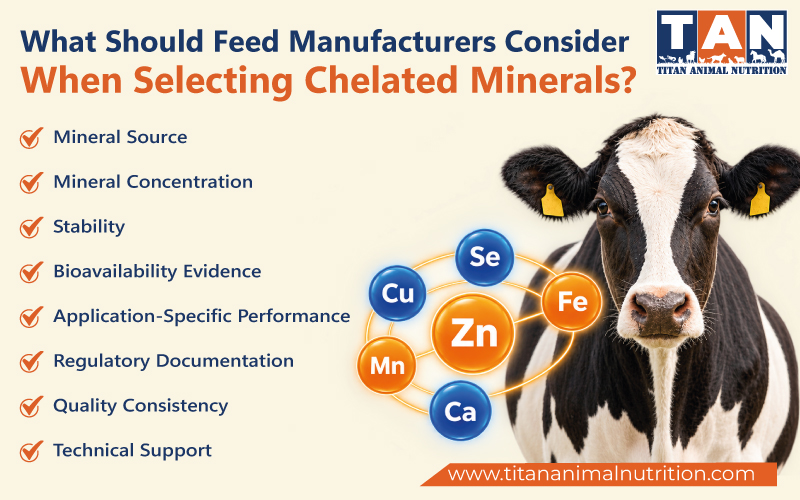
For B2B buyers, choosing an organic trace mineral should involve more than comparing the price per kilogram.
1. Mineral source
Identify whether the ingredient is an amino acid chelate, amino acid complex, proteinate, yeast-based source or another organic form.
2. Mineral concentration
Compare products based on actual elemental mineral contribution, not only product inclusion rate.
3. Stability
The stability of the mineral-ligand association can influence performance and should be supported by appropriate technical data.
4. Bioavailability evidence
Look for animal studies, comparative data and information relevant to the target species.
5. Application-specific performance
A product designed for cattle should have evidence or technical support relevant to cattle nutrition.
6. Regulatory documentation
Feed manufacturers should verify compliance with the requirements of the intended market.
7. Quality consistency
Batch-to-batch consistency is essential for premix manufacturers and feed producers.
8. Technical support
An ingredient supplier should be able to provide specifications, documentation and application guidance.
Are Chelated Minerals Always Better?
This is an important question for nutritionists and product developers.
The answer is not necessarily.
Organic trace minerals can offer advantages in certain formulations and production conditions, but their performance depends on the mineral, ligand, dose, diet, animal status and management system.
Research has produced positive findings in areas such as milk production, reproductive performance, mineral status and health, but other studies have found limited or no differences for particular outcomes.
Therefore, the most scientifically appropriate approach is not to position organic minerals as universally superior. Instead, they should be considered as precision mineral sources that can help nutritionists design targeted supplementation programs.
The B2B Opportunity for Chelated Mineral Ingredients
The growing focus on animal productivity, nutrient efficiency and sustainable livestock production is creating opportunities for specialized mineral ingredients.
For feed manufacturers and premix companies, organic trace minerals can be incorporated into:
- Dairy cattle mineral premixes
- Feed formulations for beef cattle
- Starter diets for young calves
- Nutritional blends for cows during the transition period
- Feeding programs designed to support reproductive performance
- Formulations aimed at maintaining healthy hooves
- Mineral combinations formulated to support immune function
- Nutritional solutions for periods of stress
- Comprehensive feed supplementation products
- Concentrated mineral mixes and lick blocks
The commercial opportunity is not simply about replacing every inorganic mineral. Instead, manufacturers can develop strategic mineral programs in which organic sources are used where their functional and nutritional value justifies inclusion.
About Titan Animal Nutrition: Chelated Mineral Manufacturer India for Cattle Nutrition
Titan Animal Nutrition is a group company of Titan Biotech Ltd., As a dedicated chelated mineral manufacturer India-based and globally recognized, We develop & supply a diverse selection of organic trace minerals for cattle, dairy, poultry, swine, and aquaculture applications, serving feed manufacturers, premix companies, integrators, and animal nutrition specialists throughout India and global markets.
Our chelated mineral range is available in three bases: Methionates, Glycinates and Proteinates, covering a variety of essential minerals for animal feed formulations. As a trusted organic trace mineral manufacturer and chelated mineral exporter India cattle feed brands and global companies rely on, every batch undergoes comprehensive quality testing for elemental mineral concentration, ligand stability, microbiological safety, and heavy metal compliance before release.
Titan Animal Nutrition operates as a technical partner to the cattle and livestock nutrition industry. We offer guidance on recommended inclusion levels, feed formulation, product-specific technical documentation, and regulatory requirements to assist feed producers and animal nutrition specialists in designing targeted mineral nutrition programs for transition cows, high-yielding dairy herds, beef cattle, and young calves. Whether you require a chelated zinc supplier for hoof health programs, organic selenium for reproductive nutrition, or a complete organic mineral premix for dairy cattle, Titan Animal Nutrition delivers the ingredient quality, supply reliability, and technical expertise your operation demands.
Conclusion
Chelated minerals are becoming an increasingly relevant component of modern cattle nutrition. Their fundamental value lies in the relationship between mineral form, stability, bioavailability and animal utilization. By binding minerals with suitable organic ligands, manufacturers can develop trace mineral sources designed to improve mineral delivery and reduce some of the interactions that can limit mineral availability in the digestive tract.
Research in dairy cattle has reported potential benefits involving mineral status, milk production, reproduction, metabolic health, hoof health and calf mineral status. However, findings vary across studies, highlighting the need to evaluate the mineral source, the animal’s existing nutritional status, its physiological stage, and the overall dietary composition.
For B2B feed and premix manufacturers, the future of mineral nutrition is therefore less about simply increasing mineral inclusion and more about improving mineral efficiency through scientifically informed source selection.
Chelated minerals, when appropriately specified and formulated, can be an important tool in that strategy. The next generation of cattle nutrition will increasingly focus on precision: better mineral sources, targeted supplementation, consistent quality and measurable nutritional outcomes.
Titan Animal Nutrition, a unit of Titan Biotech Ltd. and a trusted chelated mineral manufacturer India cattle feed brands and global premix companies rely on, supplies a comprehensive range of organic trace minerals including zinc methionine, copper proteinate, chelated manganese, selenium yeast, cobalt chelate, and chromium chelate for dairy cattle, beef cattle, calf starter, and transition cow formulations. As a certified organic trace mineral manufacturer and chelated mineral exporter India-based, we supply to feed manufacturers, premix producers, and livestock nutritionists across India and more than 100 countries.
Contact us at www.titananimalnutrition.com to request samples or product specifications.
Frequently Asked Questions About Chelated Minerals in Cattle
Q1. What are chelated minerals in cattle nutrition?
Chelated minerals are mineral sources in which a mineral is associated with an organic ligand such as an amino acid or peptide. The association is designed to improve mineral stability and influence its absorption and utilization in the animal.
Q2. What are the most common chelated minerals for cattle?
Common organic trace mineral sources include zinc, copper, manganese, iron, cobalt and selenium. The specific chemical form can include amino acid chelates, amino acid complexes, proteinates and yeast-derived organic minerals.
Q3. What is the difference between chelated and inorganic minerals?
Inorganic minerals are commonly supplied as salts such as sulphates, oxides and carbonates. Chelated or organic minerals are associated with organic ligands. The organic association may reduce certain interactions in the digestive tract and can improve bioavailability for some mineral sources.
Q4. Do chelated minerals improve milk production?
Certain research studies and meta-analyses have linked organic trace mineral supplementation with increases in milk yield and changes in milk composition. However, recent research has also found no significant difference in overall milk yield in some experimental conditions.
Q5. Can chelated minerals support cattle reproduction?
Trace minerals such as copper, zinc, manganese and selenium have important biological roles related to reproduction. Research has associated organic trace mineral supplementation with improvements in some reproductive outcomes, although results are not necessarily consistent across every reproductive parameter.
Q6. Which mineral is important for hoof health in cattle?
Zinc, copper and manganese are important nutrients for structural tissue and hoof integrity. A comparative study involving a large group of transition cows found that those supplemented with organic trace minerals experienced fewer cases of lameness than cows receiving inorganic mineral sources.
Q7. Is organic selenium the same as a chelated mineral?
Not necessarily. Organic selenium includes forms such as selenium yeast and selenomethionine. These forms should not be assumed to have the same characteristics as amino acid chelated minerals, including zinc and copper chelates. Selenium yeast is an important organic trace mineral source, but its chemistry and metabolism are distinct.
Q8. Are chelated minerals useful during the transition period?
They can be considered as part of a strategic transition-cow mineral program. Research has reported changes in mineral status, metabolic indicators, dry matter intake and health outcomes when organic trace minerals replaced inorganic sources during the prepartum and postpartum periods.
Q9. Can organic trace minerals benefit calves?
Maternal supplementation with organic trace minerals has been studied for its effects on calf mineral status and health. One study found higher selenium concentrations in colostrum and newborn calf serum with an organic trace mineral program, although effects on passive immunity and other outcomes were limited or variable.
Q10. Do chelated minerals reduce mineral excretion?
Improved mineral utilization may have potential to reduce unnecessary mineral excretion. However, the environmental benefit depends on mineral source, inclusion level, animal requirements and overall feeding strategy.
Q11. How should feed manufacturers select a chelated mineral?
Manufacturers should evaluate elemental mineral concentration, ligand type, stability, bioavailability evidence, regulatory compliance, microbiological quality, heavy-metal specifications, batch consistency and application-specific technical data.
Q12. Are chelated minerals suitable for all cattle?
Organic trace minerals can be used in nutritional programs for dairy cattle, beef cattle and calves, but inclusion should be based on the animal’s nutritional requirements, basal diet, production stage and applicable feed regulations.
Q13. Can chelated minerals completely replace inorganic minerals?
Not necessarily. Complete replacement is one formulation strategy that has been studied, but organic and inorganic sources can also be used strategically together.
Q14. Why is mineral source important in cattle feed?
Mineral source can influence how the nutrient behaves in the digestive tract, its interaction with other dietary components and its eventual availability to the animal. Consequently, mineral concentration alone does not fully describe nutritional value.
Q15. What should B2B buyers ask a chelated mineral supplier?
B2B buyers should request the product specification, elemental mineral assay, ligand/chelation information, stability and bioavailability data, regulatory documentation, quality certificates, contaminant limits and evidence supporting the intended species and application.
Q16. Is Titan Animal Nutrition a certified chelated mineral manufacturer for cattle nutrition in India?
Yes, Titan Animal Nutrition, a unit of Titan Biotech Ltd., is a certified chelated mineral manufacturer India-based and globally recognized, supplying zinc methionine, copper proteinate, chelated manganese, selenium yeast, cobalt chelate, and chromium chelate for dairy cattle, beef cattle, and calf nutrition to feed manufacturers, premix producers, and livestock nutritionists across India and more than 100 countries.
References:
- https://www.researchgate.net/publication/330087780_Chelated_minerals_and_its_effect_on_animal_production_A_review
- https://pmc.ncbi.nlm.nih.gov/articles/PMC11763283/#sec5-animals-15-00271
- https://www.feedipedia.org/content/organic-trace-minerals-improving-livestock-production
- https://pmc.ncbi.nlm.nih.gov/articles/PMC6274551/