
Table of Content
- Introduction
- Why Nutrient Utilization Matters So Much in Shrimp Farming
- Ox Bile Supports the Biological Functions of Bile Acids
- Better Feed Efficiency Can Translate Into Better Economics
- The Hepatopancreas: The Organ Shrimp Farmers Cannot Afford to Ignore
- Ox Bile and Lipid Metabolism: More Than Just Fat Digestion
- Bile Acids and Antioxidant Defense
- Supporting Shrimp Gut Health
- Bile Acids May Help Shrimp Make Better Use of Modern Diets
- Why Ox Bile Can Be an Attractive Functional Feed Ingredient
- Is Ox Bile Really the Biggest Investment for Shrimp Farmers?
- Why Product Standardization Matters
- What Does the Research Say About Dosage?
- Why This Could Be Especially Relevant for Intensive Shrimp Farming
- A Smarter Way to Think About Ox Bile
- The Bottom Line: Is Ox Bile Worth the Investment?
- Final Takeaway
- Frequently Asked Questions (FAQ)
- About Titan Animal Nutrition
- References
Introduction
Shrimp farming is a business where small improvements in feed efficiency, growth, survival and animal health can have a meaningful impact on profitability. Feed is one of the largest operating expenses in intensive shrimp production, while poor nutrient utilization can increase feed costs, waste output and pressure on water quality.
This is why functional feed additives that help shrimp make better use of nutrients are attracting increasing attention.
Among these, ox bile extract is emerging as an interesting ingredient because bile acids are closely involved in lipid digestion, nutrient metabolism, antioxidant defense, immunity and intestinal function. Research in Litopenaeus vannamei, the Pacific white shrimp, has increasingly demonstrated that dietary bile acid supplementation can influence several of these biological processes.
Recent research has strengthened scientific interest. Studies published between 2021 and 2026 have reported improvements in growth, digestive enzyme activity, lipid metabolism, antioxidant status, hepatopancreas health and, in some experiments, gut microbial characteristics following dietary bile acid supplementation.
For shrimp farmers, the bigger question is not simply whether bile acid works. The more relevant question is whether improving nutrient utilization and metabolic efficiency can make bile-derived ingredients a worthwhile investment in a commercial shrimp production system. The evidence suggests there is a compelling opportunity, but it should be approached scientifically and with appropriate product standardization.
Why Nutrient Utilization Matters So Much in Shrimp Farming
A shrimp farmer does not simply invest in feed. The real investment is in the nutrients contained in that feed. Protein, lipids, essential fatty acids, cholesterol, vitamins and minerals must be digested, absorbed and metabolized efficiently for shrimp to convert feed into biomass.
If nutrients are poorly utilized, several problems can follow:
- Higher feed requirement
- Increased feed conversion ratio
- Greater organic waste
- Increased metabolic stress
- Poorer growth consistency
This makes feed efficiency one of the most important economic considerations in shrimp farming. Bile acids are particularly relevant because they participate in lipid digestion and metabolism. Research in Pacific white shrimp has demonstrated that dietary bile acids can increase digestive enzyme activities and influence lipid metabolism. That gives ox bile extract an important potential role as a functional feed ingredient rather than simply another additive.
Ox Bile Supports the Biological Functions of Bile Acids
Bile is naturally associated with digestion and lipid handling. Ox bile extract contains bile-derived components, including bile acids such as cholic acid and related compounds, depending on the source and processing method.
In formulated shrimp diets, supplemental bile acids may help support the biological processes involved in:
Fat digestion, lipid absorption, nutrient utilization, energy metabolism, and growth.
Research has shown that bile acid supplementation can increase digestive enzyme activity in L. vannamei. In a 2021 study, shrimp receiving dietary bile acids showed increased activities of protease, lipase and superoxide dismutase, with the researchers recommending approximately 0.2 g/kg under the conditions tested.
This is particularly interesting because lipase is directly involved in lipid digestion. For farmers, better lipid utilization can mean that the nutrients already present in the feed are potentially used more efficiently.
Better Feed Efficiency Can Translate Into Better Economics
One of the strongest arguments for considering ox bile-derived ingredients in shrimp diets is the potential relationship between bile acid supplementation and feed utilization.
A 2023 Aquaculture Reports study investigated supplemental bile acids in low-fishmeal diets for Pacific white shrimp. The researchers reported that supplementation at 75 to 300 mg/kg improved hepatopancreas health, while 150 mg/kg significantly decreased feed conversion ratio. This finding deserves attention.
FCR is one of the most commercially important parameters in shrimp farming because it connects feed consumption with biomass production. A functional ingredient does not need to replace the entire diet to create economic value. If a relatively small inclusion of a feed additive helps improve nutrient utilization or FCR, the economic return may come from better utilization of the existing feed investment.
That is why ox bile can be viewed as a potentially strategic investment rather than simply an additional feed cost.
The Hepatopancreas: The Organ Shrimp Farmers Cannot Afford to Ignore
In shrimp, the hepatopancreas plays central roles in digestion, nutrient absorption, metabolism, storage and detoxification. Consequently, maintaining hepatopancreatic function is fundamental to shrimp performance. Research has repeatedly demonstrated the importance of the hepatopancreas in shrimp health, particularly under nutritional and environmental stress.
Importantly, bile acid research has also produced encouraging findings in this area. The 2023 low-fishmeal study reported improved hepatopancreas health following dietary bile acid supplementation.
A more recent multi-omics study investigating bile acid supplementation in L. vannamei reported that supplementation improved growth while alleviating certain hepatopancreatic changes in shrimp receiving a low-fishmeal diet.
This matters because intensive shrimp farming frequently exposes animals to multiple simultaneous pressures. Maintaining metabolic organs in good condition can therefore be an important part of a broader nutritional management strategy.
Ox Bile and Lipid Metabolism: More Than Just Fat Digestion
It would be too simplistic to describe bile acids merely as fat digesters. Modern shrimp research indicates that bile acids participate in broader metabolic regulation.
A 2026 study examining six individual bile acids in juvenile Pacific white shrimp found that different bile acids produced different metabolic effects. Several bile acids reduced hemolymph triglycerides, while cholic acid, chenodeoxycholic acid and hyocholic acid reduced hepatopancreatic lipid levels. The treatments also reduced malondialdehyde, a marker associated with oxidative damage.
This is an important development. It suggests that the biological effects of bile acids may extend beyond emulsification and digestion into:
- Lipid turnover
- Cholesterol metabolism
- Oxidative balance
- Cellular metabolism
- Nutrient utilization
Therefore, the value of a bile-derived ingredient may lie in its ability to support overall metabolic efficiency.
Bile Acids and Antioxidant Defense in Shrimp
Shrimp farming is not a stress-free environment. High stocking densities, fluctuating water parameters, temperature changes, handling, nutritional challenges and exposure to environmental stressors can all influence oxidative balance.
Oxidative stress occurs when the generation of reactive oxygen species exceeds the animal’s ability to neutralize them. Bile acid supplementation has shown potential effects on antioxidant systems in shrimp.
The 2021 study found increases in glutathione, total antioxidant capacity and superoxide dismutase activity in several bile acid treatment groups. Similarly, a 2026 study found that dietary bile acids significantly enhanced nonspecific immune-related parameters and total antioxidant capacity in L. vannamei.
These findings are particularly relevant for intensive aquaculture because antioxidant capacity forms part of the shrimp’s physiological response to stress.
However, bile acids should not be marketed as a cure for environmental stress or disease. Rather, their potential role should be positioned as nutritional support for metabolic and antioxidant functions.
Supporting Shrimp Gut Health with Bile Acid Supplementation
The shrimp gut is more than a digestive tube. It is a dynamic biological environment containing microorganisms that interact with nutrition, metabolism and host physiology.
Research has shown that dietary bile acids can influence shrimp intestinal microbiota. In the 2021 Aquaculture Nutrition study, bile acid supplementation altered intestinal microbial diversity and richness, while functional genes associated with metabolism and bile acid biotransformation were affected.
More recent research has further strengthened this area. A 2025 study on post-larval L. vannamei reported that dietary bile acid supplementation improved growth, antioxidant capability, lipid metabolism and gut microbiota characteristics.
Another study examining fermented bile acids reported improvements in growth performance and intestinal health, together with changes in metabolic and microbiota-related parameters. This makes the gut-hepatopancreas relationship an increasingly interesting area for shrimp nutrition research.
Bile Acids May Help Shrimp Make Better Use of Modern Diets
Shrimp feeds are evolving. The industry has increasingly explored alternatives to traditional high-fishmeal formulations because of sustainability, availability and cost considerations.
But changing protein and lipid sources can also alter nutrient digestibility and metabolic responses. This is where functional ingredients may become increasingly important.
A 2023 study specifically evaluated bile acid supplementation in a low-fishmeal diet and found improvements in growth-related and hepatopancreatic parameters. Another study examining dietary cholesterol and bile acids reported that bile acids could exert a cholesterol-sparing effect, while also increasing hepatopancreatic protease and lipase activity and enhancing antioxidant capacity.
This suggests an important commercial concept: the future of shrimp nutrition may not simply be about adding more nutrients. It may be about helping shrimp utilize nutrients more efficiently.
Why Ox Bile Can Be an Attractive Functional Feed Ingredient
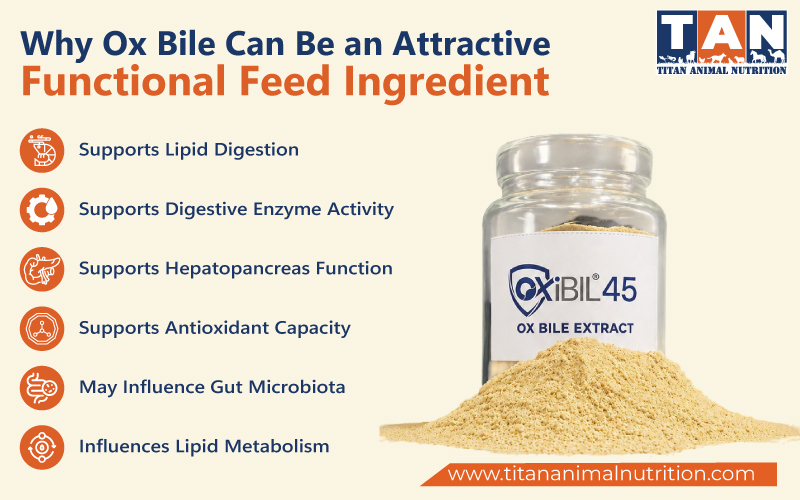
From a formulation perspective, ox bile extract has several characteristics that make it interesting for aquaculture applications.
1. Supports lipid digestion
Bile acids are fundamentally associated with lipid digestion and utilization, making them relevant to high-energy shrimp diets.
2. Supports digestive enzyme activity
Experimental studies have reported increases in enzymes such as lipase and protease following bile acid supplementation.
3. Supports hepatopancreas function
Several studies have associated dietary bile acid supplementation with improved hepatopancreatic biochemical or histological parameters.
4. Supports antioxidant capacity
Studies have reported improvements in antioxidant-related parameters, including superoxide dismutase, glutathione and total antioxidant capacity.
5. Influences lipid metabolism
Recent molecular studies indicate that bile acids can influence pathways associated with lipid synthesis and breakdown.
6. May influence gut microbiota
Research has identified changes in microbial diversity and bacterial communities following bile acid supplementation.
Is Ox Bile Really the Biggest Investment for Shrimp Farmers?
The phrase biggest investment should be understood as a marketing concept rather than a scientific conclusion. Ox bile is not a replacement for good seed, water-quality management, biosecurity, appropriate stocking density, balanced feed or disease prevention. However, it could become one of the most strategic nutritional investments when used correctly.
Why? Because its potential benefits touch several economically important areas simultaneously:
- Feed utilization
- Digestive efficiency
- Lipid metabolism
- Hepatopancreas support
- Antioxidant capacity
- Gut health
- Growth performance
This multi-functional potential is what makes bile-derived ingredients particularly interesting.
Why Product Standardization Matters?
Not every ox bile extract should be considered equivalent. The biological activity of a commercial product can depend on:
- Total bile acid concentration
- Cholic acid content
- Other bile acid composition
- Source material
- Extraction process
- Purification
- Moisture
- Microbiological quality
- Batch-to-batch consistency
- Stability during feed processing
This is particularly important because recent research demonstrates that individual bile acids do not necessarily produce identical effects.
A 2026 study comparing six individual bile acids in juvenile Pacific white shrimp found that their effects on lipid metabolism differed substantially. Therefore, formulators should avoid assuming that results obtained with one purified bile acid automatically apply to every ox bile extract. For commercial use, a standardized, specification-driven ox bile extract provides a more rational formulation approach.
What Does the Research Say About Dosage?
This is one area where caution is essential. There is no single universal shrimp ox bile dosage that can be applied to every product and farming system.
Research has tested different bile acid preparations at different inclusion levels. For example:
- A 2021 study recommended approximately 0.2 g/kg dietary bile acids under its experimental conditions.
- A 2023 low-fishmeal study evaluated 75 to 300 mg/kg, with 150 mg/kg producing a significant reduction in FCR.
- A 2025 study identified an optimal bile acid range of approximately 216 to 218 mg/kg under its experimental conditions.
- A 2026 multi-omics study identified approximately 200 mg/kg as a physiological optimum in the experimental design.
These results are useful for formulation research but should not be interpreted as a universal recommendation for ox bile extract. The appropriate inclusion level depends on the product’s active bile acid profile, diet composition, shrimp size, farming conditions and intended application.
Why This Could Be Especially Relevant for Intensive Shrimp Farming
Modern shrimp production increasingly focuses on precision nutrition. Farmers want more than simply good feed. They want feed that can deliver:
- Efficient feed conversion
- Consistent performance
- Strong metabolic health
- Lower unnecessary nutrient losses
Functional ingredients fit naturally into this approach. Ox bile extract can potentially contribute to this strategy by providing bile-derived compounds that participate in digestion and metabolism. The goal is not to feed more.
The goal is to help shrimp utilize what they are already being fed more effectively. That distinction could make bile-derived ingredients increasingly valuable as shrimp diets become more sophisticated.
A Smarter Way to Think About Ox Bile
For shrimp farmers and feed manufacturers, ox bile should not be positioned as a miracle additive. A more scientifically defensible positioning is:
Ox bile extract is a functional bile-derived ingredient designed to support lipid digestion, nutrient utilization and metabolic health in shrimp diets.
This positioning aligns better with the available evidence. It also gives feed formulators room to develop products around measurable parameters such as:
- FCR
- Weight gain
- Specific growth rate
- Feed intake
- Survival
- Hepatopancreas condition
- Protease activity
- Antioxidant status
- Hemolymph biochemical parameters
These parameters can help demonstrate whether a particular ox bile product is delivering meaningful value under commercial conditions.
The Bottom Line: Is Ox Bile Worth the Investment?
The scientific evidence around dietary bile acids in shrimp has evolved considerably. Studies in Litopenaeus vannamei indicate that dietary bile acid supplementation can influence growth performance, feed utilization, digestive enzymes, lipid metabolism, antioxidant defense, hepatopancreas health and gut microbiota.
That makes ox bile extract an intriguing functional ingredient for modern shrimp nutrition. But the strongest commercial argument is not that ox bile does everything. It is that bile-derived compounds potentially influence several biological processes connected to the economics of shrimp production. For a farmer, the investment equation ultimately comes down to:
Cost of supplementation versus measurable improvement in production efficiency.
If a standardized ox bile extract can help improve nutrient utilization, support hepatopancreatic function and contribute to better feed efficiency, even a relatively low inclusion rate could potentially create value across an entire production cycle.
That is why ox bile deserves serious consideration, not as a replacement for good farming practices, but as a precision nutrition tool for more efficient shrimp production.
Final Takeaway
The future of profitable shrimp farming is not simply about feeding more. It is about extracting more value from every kilogram of feed.
Ox bile extract, through its bile acid content and associated biological functions, has the potential to become an important part of that strategy.
For feed manufacturers, aquaculture nutritionists and shrimp farmers, the next step should be product-specific validation through controlled feeding trials, with FCR, growth, survival, hepatopancreas health and economic return measured together. That is where ox bile can move from being an interesting ingredient to becoming a measurable investment in shrimp production efficiency.
Frequently Asked Questions (FAQ)
Q1. What is ox bile extract and why is it used in shrimp feed?
Ox bile extract is a standardized bovine-derived bile acid ingredient that supports lipid digestion, nutrient utilization, digestive enzyme activity, hepatopancreas function, and antioxidant defense in shrimp diets, making it a functional feed additive for commercial shrimp farming.
Q2. How does ox bile extract improve feed efficiency in shrimp farming?
Dietary bile acids increase lipase and protease activity in the hepatopancreas, improving fat and protein digestion, which allows shrimp to extract more energy and nutrients from the same feed quantity, directly reducing feed conversion ratio and production cost.
Q3. What is the recommended dosage of ox bile extract for shrimp feed?
Published research has reported effective ranges of approximately 150 to 200 mg/kg dietary bile acids for Pacific white shrimp, though the optimal inclusion depends on the product’s active bile acid profile, diet composition, shrimp size, and farming conditions.
Q4. Can bile acids help shrimp on low-fishmeal diets?
Yes, a 2023 Aquaculture Reports study confirmed that bile acid supplementation at 150 mg/kg significantly decreased FCR and improved hepatopancreas health in Pacific white shrimp fed low-fishmeal diets, supporting sustainable feed formulation strategies.
Q5. Does ox bile extract support hepatopancreas health in shrimp?
Yes, multiple studies have associated dietary bile acid supplementation with improved hepatopancreatic biochemical and histological parameters in Litopenaeus vannamei, making hepatopancreas support one of the most consistently reported benefits in the research.
Q6. Can bile acids improve antioxidant defense in shrimp?
Research has reported significant improvements in superoxide dismutase activity, total antioxidant capacity, and glutathione levels in shrimp receiving dietary bile acid supplementation, supporting the animal’s physiological response to oxidative stress in intensive farming conditions.
Q7. Are all ox bile extracts the same quality for shrimp nutrition?
No, biological activity varies significantly depending on total bile acid concentration, cholic acid content, source material, extraction method, purification process, and batch consistency, which is why a standardized, specification-driven ox bile extract from a reliable aquaculture bile acid supplier is essential for predictable results.
Q8. Is Titan Animal Nutrition a certified ox bile extract manufacturer for aquaculture?
Yes, Titan Animal Nutrition, a unit of Titan Biotech Ltd., is a certified ox bile extract manufacturer for aquaculture, supplying Oxibil®45 standardized bile acid feed additive to shrimp feed manufacturers, aquaculture premix producers, and farm nutritionists across India and global markets.
Q9. How can I source bulk ox bile extract for shrimp feed manufacturing?
Contact Titan Animal Nutrition to request OXIBIL® samples, technical data sheets, bile acid standardization specifications, and commercial pricing for bulk ox bile extract for shrimp and aquaculture feed applications.
About Titan Animal Nutrition: Ox Bile Extract Manufacturer for Aquaculture
Titan Animal Nutrition is a specialized animal nutrition ingredient manufacturing unit of Titan Biotech Ltd. As a dedicated ox bile extract manufacturer for aquaculture and a trusted aquaculture bile acid supplier India-based and globally recognized, we produce OXIBIL®, a standardized bile acid feed additive developed for shrimp, fish, poultry, and livestock nutrition applications.
OXIBIL® is produced from quality-assured bovine raw material and standardized for total bile acid content and cholic acid concentration, ensuring consistent potency and predictable biological activity across every production batch. As a certified ox bile exporter India aquaculture feed companies and global shrimp feed manufacturers rely on, every batch undergoes comprehensive quality testing for active bile acid concentration, microbiological safety, and physical consistency before release.
Titan Animal Nutrition operates as a technical partner to the aquaculture nutrition industry. Whether you are a shrimp feed manufacturer seeking a reliable bulk ox bile extract supplier, an aquaculture nutritionist formulating for low-fishmeal diets, or a shrimp farm integrator evaluating precision nutrition tools for FCR improvement, OXIBIL® delivers the scientific backing, product standardization, and supply reliability your program requires.
Scientific References
-
- Su C. et al. (2021). Effects of bile acids on the growth performance, lipid metabolism, non-specific immunity and intestinal microbiota of Pacific white shrimp (Litopenaeus vannamei). Aquaculture Nutrition, 27, 2029–2041. The study evaluated 0–0.5 g/kg dietary bile acids over 60 days and reported effects on growth, lipid metabolism, digestive enzymes, antioxidant capacity and intestinal microbiota.
Read the study - Supplemental bile acids in low fishmeal diet improved the growth, nutrient utilization of Pacific white shrimp (Litopenaeus vannamei) (2023). Aquaculture Reports, 28, 101452. The study reported improved hepatopancreas health and a significant reduction in FCR at 150 mg/kg bile acids.
Read the study - Effects of Dietary Chenodeoxycholic Acid Supplementation in a Low Fishmeal Diet Containing Clostridium autoethanogenum Protein on Growth, Lipid and Cholesterol Metabolism, and Hepatopancreas Health of Litopenaeus vannamei (2023).
Read the PubMed record - The impact of bile acid supplementation in the diet of post-larval shrimp: Growth performance, lipid metabolism, gut microbiota, and molecular responses (2025). Aquaculture Reports, 43, 103012. The study reported improved growth, antioxidant capability, lipid metabolism and gut microbiota characteristics.
Read the study - Dietary Bile Acids Supplementation on Growth Performance and Metabolism in Pacific White Shrimp (Litopenaeus vannamei) (2025). Multi-omics analysis identified an experimental optimum of approximately 216–218 mg/kg and reported effects on growth, digestive enzymes and lipid metabolism.
Read the full study - Integrated multi-omics analyses reveals physiological and gut microbiota responses of Litopenaeus vannamei to graded levels of dietary bile acids (2026). The study investigated 0–1000 mg/kg bile acids and reported effects on antioxidant capacity and nonspecific immune parameters.
Read the PubMed record - Effects of Different Monomeric Bile Acids in the Diet on the Growth and Lipid Metabolism of Juvenile Pacific White Shrimp (2026). Animals, 16(12), 1925. This research highlights that individual bile acids can have different effects on lipid metabolism and oxidative status.
Read the full study - Effects of bile acids on aflatoxin B1 bioaccumulation, detoxification system, and growth performance of Pacific white shrimp (2021). Food Chemistry. The study investigated bile acids in relation to AFB1 exposure and reported effects on detoxification and oxidative stress parameters.
Read the PubMed record
- Su C. et al. (2021). Effects of bile acids on the growth performance, lipid metabolism, non-specific immunity and intestinal microbiota of Pacific white shrimp (Litopenaeus vannamei). Aquaculture Nutrition, 27, 2029–2041. The study evaluated 0–0.5 g/kg dietary bile acids over 60 days and reported effects on growth, lipid metabolism, digestive enzymes, antioxidant capacity and intestinal microbiota.