
Table of Content
- Introduction
- Understanding Ox Bile Extract and Bile Acids in Poultry Nutrition
- Mechanisms of Action in Laying Hens
- Clinical Studies: Evidence from Trials on Layers
- Practical Applications in Layer Farming
- Potential Challenges and Safety
- Future Directions
- Conclusion
- Frequently Asked Questions (FAQ)
- About Titan Biotech Ltd
- References
Introduction
In the competitive world of commercial egg production, laying hens (often simply called “layers”) face intense physiological demands. High egg output, intensive housing, and energy-dense diets put enormous pressure on their digestive and metabolic systems, particularly the liver. Ox bile extract, a natural source of bile acids derived from Bovine, has emerged as a valuable feed additive. It supports fat digestion, nutrient absorption, liver function, and overall productivity. While much early research focused on broilers, growing evidence from clinical trials demonstrates its benefits for layers, especially in late production phases or under stress from high-fat diets.
This article explores the science behind ox bile extract, its mechanism in poultry, practical applications in layer diets, key findings from studies, safety considerations, and economic implications. Written for poultry nutritionists, farm managers, and veterinarians, it draws on peer-reviewed trials while remaining accessible.
Understanding Ox Bile Extract and Bile Acids in Poultry Nutrition
Bile is a yellowish-green fluid produced by the liver and stored in the gallbladder. It contains bile acids (or bile salts) that emulsify dietary fats, breaking them into smaller droplets for easier digestion by lipase enzymes. In birds, the liver produces bile continuously, but high-production layers, especially those on energy-rich feeds, may not secrete enough, leading to incomplete fat utilization, liver overload, and issues like fatty liver haemorrhagic syndrome (FLHS).
Ox bile extract is desiccated or powdered bile from Bovine, standardized for cholic acid or total bile acids. It provides exogenous bile salts like cholic acid, chenodeoxycholic acid, and others. These supplement the bird’s own production, improving lipid emulsification, micelle formation, and absorption of fats and fat-soluble vitamins (A, D, E, K).
In layers, this is particularly relevant because egg yolk formation relies heavily on lipids. Poor digestion of dietary fats may negatively affect energy use, hinder nutrient absorption essential for eggshell formation, and elevate the risk of metabolic complications. Supplementation helps unload the liver by promoting better nutrient partitioning and toxin clearance via bile flow.
Unlike synthetic emulsifiers, ox bile extract is natural and may offer additional antibacterial benefits by disrupting pathogen membranes in the gut.
Mechanisms of Action in Laying Hens
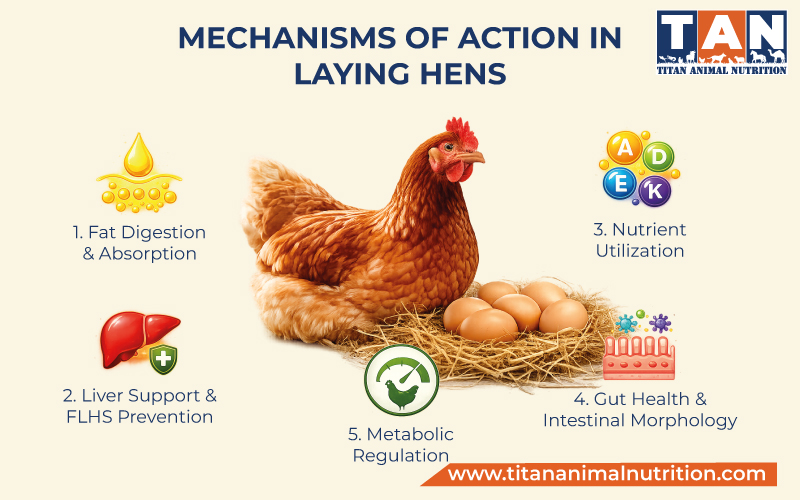
1. Fat Digestion and Absorption: Bile acids lower the surface tension of fat globules, enabling effective lipase action. This increases the digestibility of saturated fats, which are common in poultry diets formulated with tallow or vegetable oils. The result is more available energy for egg production without requiring a proportional increase in feed intake.
2. Liver Support and FLHS Prevention: Modern layers often develop fatty liver due to excess energy intake, estrogen-driven lipogenesis, and limited exercise in cage systems. Bile acids stimulate bile flow, help export accumulated fats from the liver, reduce lipid accumulation in hepatic tissue, and mitigate oxidative stress. They also bind endotoxins and support the liver’s natural detoxification pathways. This protective mechanism is particularly important during peak lay and in the later stages of the production cycle.
3. Nutrient Utilization: Enhanced absorption of fat-soluble vitamins directly improves calcium metabolism, which is critical for eggshell quality, as well as immune function. Better uptake of carotenoid pigments can improve yolk color, an important quality trait in premium egg markets.
4. Gut Health and Intestinal Morphology: Supplementation can improve intestinal morphology by promoting taller villi and greater absorptive surface area, leading to superior nutrient uptake and a more balanced gut microbiome throughout the production cycle.
5. Metabolic Regulation: Bile acids act as signaling molecules via receptors including FXR and TGR5, influencing lipid and glucose homeostasis. This signaling function may reduce fat deposition in the liver while simultaneously supporting the energy supply needed for sustained egg production. These combined mechanisms make ox bile extract especially useful in late-lay hens beyond 50 to 60 weeks, where production decline and liver strain tend to increase.
These mechanisms make ox bile extract especially useful in late-lay hens (after 50-60 weeks), where production drops and liver strain increases.
Clinical Studies: Evidence from Trials on Layers
Several controlled trials provide solid data. Here’s a review of key ones:
Bile Acids in High-Fat Diet Layers (Li et al., 2024): Published in Animals, this study showed bile acid supplementation in hens on high-fat diets improved production performance and egg quality by enhancing antioxidant capacity and reducing liver lipid accumulation. It directly addressed FLHS-like conditions.
Vitamin B12/Biotin + Bile Acids Trial (El-Katcha et al.): In 270 Isa Brown layers (53 weeks old) over 8 weeks, 400 g/ton dried bile acids combined with vitamins improved FCR, supported egg production (especially with B12), and showed non-significant but positive trends in fat digestibility. Liver fat content tended lower, with no adverse histopathology. Biotin alone had mixed effects, but bile acids helped stabilize performance.
Broader Context from Related Research: While many ox bile studies focus on broilers (e.g., Alzawqari et al., 2011, showing linear increases in fat digestibility from 51% to 84% with 0-0.5% desiccated ox bile, plus better gut morphology), principles translate to layers. Improved fat utilization supports the high lipid demands of yolk formation.
Older studies (e.g., Edwards 1962) noted potential negatives with specific bile acids like lithocholic acid at high levels, but modern extracts (balanced profiles) avoid this at recommended doses.
Practical Applications in Layer Farming
Dosage and Inclusion: Typical recommendations are 60-200 mg/kg (or ppm) total bile acids, or 0.25-0.5% for desiccated ox bile extract, depending on standardization (e.g., 7% cholic acid products). Start low in peak lay and increase in late lay or with high-fat diets. Mix uniformly in mash or pellet feeds.
When to Use:
- Late production phases (50+ weeks) to sustain lay and reduce mortality.
- Diets with added fats/oils or variable quality ingredients.
- FLHS-prone flocks (caged layers with limited activity).
- To improve eggshell quality and yolk pigmentation for premium markets.
- During heat stress or disease challenges affecting liver function.
Synergies: Combine with choline, methionine (lipotropics), or antioxidants like vitamin E for amplified liver protection. Probiotics may complement gut benefits.
Monitoring: Track egg production curves, FCR, mortality, eggshell quality (thickness, strength), yolk color (Roche fan), and liver health via necropsy or blood enzymes (ALT/AST).
Economic Benefits: Even modest performance gains deliver meaningful financial returns. A 2 to 3% improvement in egg production, an FCR improvement of 0.05 to 0.10, and reduced mortality each contribute independently to the economic case. The reduction in FLHS losses, which can drive flock mortality to 50 to 70% in severe outbreaks, adds significant value. Fewer cracked eggs from improved shell quality further reduces grading losses and improves saleable output per bird.
Potential Challenges and Safety
Bile extracts are generally recognized as safe. Trials show no adverse effects at practical levels, with high doses (50x) revealing limits like reduced yolk color or mild organ stress. Always source high-quality, standardized products to avoid contaminants. Over-supplementation is wasteful and unnecessary. Consult nutritionists for diet-specific formulation, as responses vary by breed, age, and basal diet fat content.
Antibacterial properties may help control pathogens, but it’s not a replacement for biosecurity or antibiotics where needed.
Future Directions
Current research gaps include long-term multi-generation studies, optimized combination protocols with other functional additives, and more precise characterization of bile acid mechanisms in layers including microbiome shifts and gene expression responses. These remain active areas of scientific investigation.
Climate change and sustainability pressures are increasing demand for natural feed additives that reduce reliance on antimicrobials and improve resource efficiency. Ox bile extract fits this trajectory by addressing the root causes of metabolic inefficiency in high-production layer flocks. As the global egg industry continues to grow, tools that extend the productive life of layers, improve bird welfare, and reduce the environmental footprint of egg production will become increasingly important.
Conclusion
Ox bile extract offers a science-backed, practical solution for modern layer operations. By enhancing fat digestion, supporting liver health, boosting nutrient uptake, and improving key performance metrics like egg output, shell quality, and FCR, it helps producers meet demands profitably and sustainably. Clinical studies consistently show benefits at moderate inclusions (around 60 mg/kg bile acids), with a strong safety margin.
Farmers should integrate it thoughtfully, backed by flock monitoring. As with any additive, results depend on overall management. With continued research, ox bile extract could become a standard in layer nutrition, much like it has gained traction in broilers.
Frequently Asked Questions (FAQ)
Q1. What is ox bile extract and how does it benefit laying hens?
Ox bile extract is a standardized bovine-derived bile acid supplement that improves fat digestion, supports liver health, and enhances nutrient absorption in laying hens, resulting in better egg production and feed efficiency.
Q2. How does ox bile extract prevent fatty liver haemorrhagic syndrome in layers?
Bile acids stimulate bile flow, promote fat export from the liver, reduce lipid accumulation in hepatic tissue, and mitigate oxidative stress, all of which together reduce the risk of fatty liver haemorrhagic syndrome in high-production layer flocks.
Q.3 At what age or production stage should ox bile extract be introduced in layer diets?
Ox bile extract is most beneficial from 50 weeks onward when natural digestive efficiency declines, though it can also be used during peak lay on high-fat diets or during heat stress periods to maintain fat digestion performance.
Q.4 Can ox bile extract improve eggshell quality?
Yes, by improving the absorption of fat-soluble vitamin D and calcium, ox bile extract supplementation supports better calcium metabolism in the hen, which directly contributes to improved eggshell thickness and strength.
Q5. How much ox bile extract should be included in layer feed?
Typical inclusion is 60 to 200 mg/kg total bile acids or 0.25 to 0.5% desiccated ox bile extract, depending on product standardization, production phase, and basal diet fat content.
Q6. Is ox bile extract safe for use in laying hens?
Yes, ox bile extract is recognized as safe at practical inclusion levels, with clinical trials showing no adverse effects, and safety margins established at doses well above commercial recommendations.
Q7. Can ox bile extract improve yolk color in eggs?
Yes, because ox bile extract enhances carotenoid pigment absorption through improved fat digestion, it can contribute to deeper, more consistent yolk pigmentation, which is a valued quality trait in premium egg markets.
Q8. Does Titan Animal Nutrition supply ox bile extract for commercial layer operations?
Yes, Titan Animal Nutrition is a dedicated ox bile extract manufacturer and animal nutrition supplier, providing standardized bovine bile extract formulations for laying hen, poultry, and livestock nutrition through www.titananimalnutrition.com.
About Titan Animal Nutrition: OXIBIL® Ox Bile Extract Manufacturer
Titan Animal Nutrition is a specialized animal feed additive company under Titan Biotech Ltd., a leading Indian manufacturer of nutraceutical, pharmaceutical, and animal nutrition ingredients. As a dedicated OXIBIL® ox bile extract manufacturer, we develop and supply standardized bovine bile acid formulations for poultry and livestock nutrition to feed manufacturers, nutritionists, integrators, and commercial producers across India and global markets.
Our OXIBIL® ox bile extract is produced from quality-assured bovine raw material, standardized for total bile acid content, and tested for microbiological safety and physical consistency before every release. Every batch is manufactured under strict quality control procedures, ensuring consistent potency and predictable performance for our customers.
Whether you are a feed manufacturer, poultry nutritionist, or commercial layer producer, Titan Animal Nutrition delivers the product quality, scientific backing, and supply reliability your operation demands.
References:
- Yang et al. (2022). Safety Evaluation of Porcine Bile Acids in Laying Hens. Frontiers in Veterinary Science.
- Li et al. (2024). Effect of Bile Acids Supplementation in Fatty Liver… Animals.
- Application of bile acids in laying hens. All About Feed.
- Alzawqari et al. (2011). Desiccated ox bile in broilers. Journal of Applied Animal Research.
- El-Katcha et al. Vitamin/Bile acids trial. Slovenian Veterinary Research.